
Something Smells in Quonset And It’s Not Just the Sludge
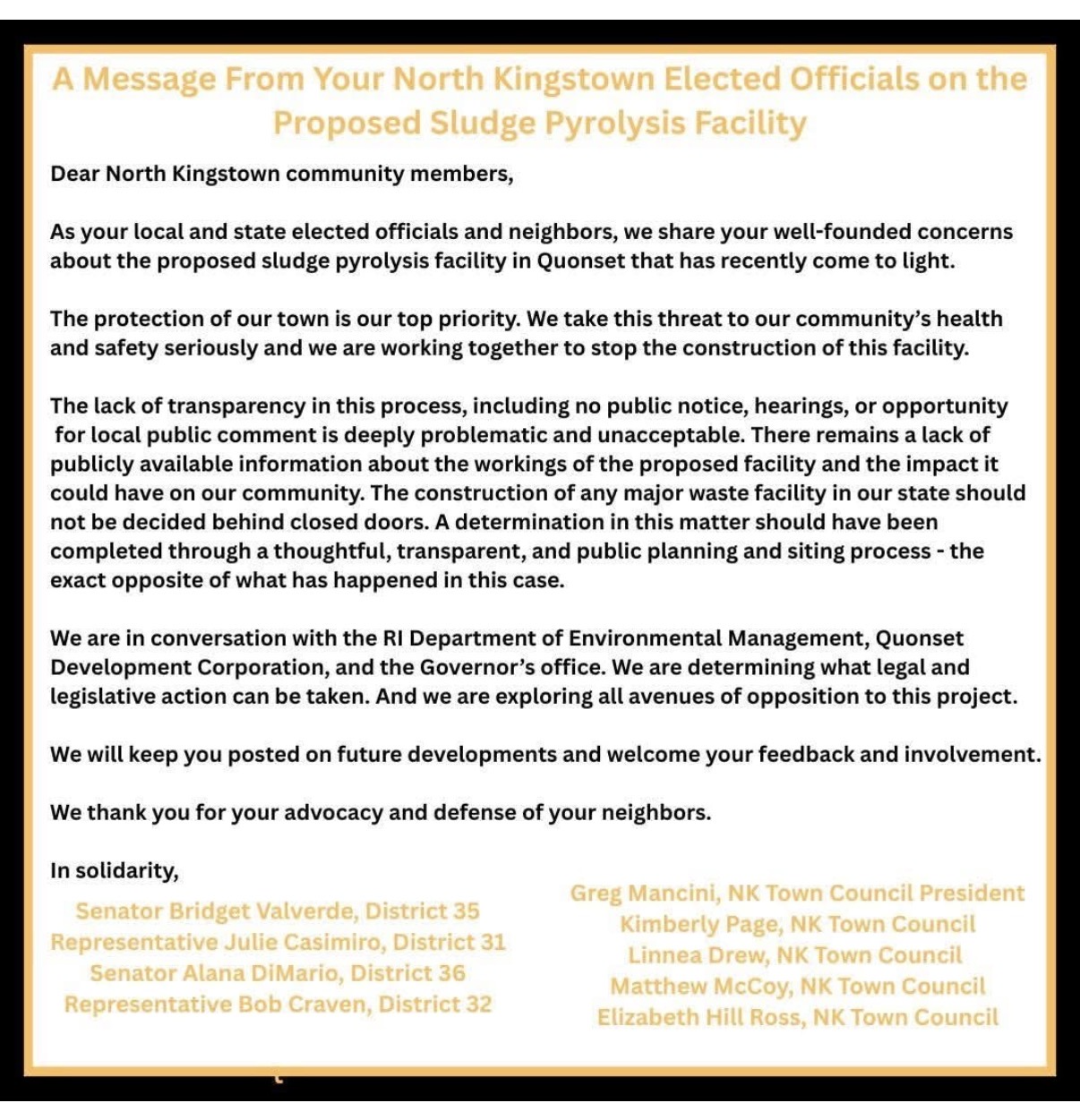
This is the public statement released by local and state officials. Read it carefully, especially the claims about transparency and timing.
There’s a lot of concern right now about the proposed sludge facility at Quonset, and there should be.
Projects like this raise real questions about environmental impact, air quality, and quality of life for the surrounding community.
If we’re going to make environmental decisions, they should be driven by data, not timing.
People deserve answers, and as I’ve looked more closely at how this unfolded, one thing stands out: This didn’t just happen overnight.
A Decision Was Made In 2024
On November 19, 2024, the Quonset Development Corporation approved a ground lease for this project in a publicly noticed meeting by a recorded vote of 5–3.
Notably, two of the “no” votes came from North Kingstown representation including Town Council member Matthew McCoy, who is also named in the public statement above.
That matters.
It means this project wasn’t just theoretical. It reached a formal decision point months ago, with local representation actively involved.
Yet for most residents, this is only now coming to light.
Now we’re seeing a joint statement from elected officials expressing concern and standing “in solidarity” with residents, and I appreciate that, but it raises a fair question:
Where Was the Engagement Before Now?
Not every elected official sits on the Quonset board.
That’s true.
But Quonset is one of the most important economic engines in our state and a central part of North Kingstown.
It’s reasonable to expect a level of awareness and engagement when something of this scale is being considered.
This plant wasn’t proposed.
It was voted on.
Where’s the Analysis?
One part of the public statement from our elected officials jumped out at my engineer brain:
Elected officials say they are “working together to stop the construction of this facility” and are “exploring all avenues of opposition.”
That’s a strong position, and it raises an important question: Based on what?
Is this a reaction to public outcry or based on science?
If this project presents environmental or health risks, then the public deserves to see:
the data
the emissions modeling
the risk assessments
and the specific concerns driving that conclusion
Right now, what we have is a position without a clearly stated rationale, and that’s not how decisions like this should be made.
A public statement calling out a lack of transparency shouldn’t create more of it.
Consistency Matters
Both State Senators representing North Kingstown supported the Act on Climate, one of the most aggressive climate laws in the country.
They’ve been clear about that support, and they’ve publicly argued we need to stay the course, even as it becomes clear we’re not on track to meet the goals set in the law within the required timelines.
That’s a position grounded in long-term environmental goals.
Now, we have a project like this.
A project that raises real questions and deserves real scrutiny.
And yet the response isn’t:
Here’s the data.
Here’s the analysis.
Here’s why this doesn’t make sense.
Instead, it’s immediate opposition.
Once again, is this about the science or is it a reaction to public pressure?
This Isn’t About One Project
Rhode Island does have a real biosolids problem to solve.
That’s not controversial.
Any solution is going to involve:
infrastructure
tradeoffs
and careful planning
That makes transparency and early communication even more important, not less.
When the public is brought in late, after key steps have already been taken, trust erodes.
This Is a Leadership Test
There are only a few possibilities in situations like this:
Either leadership was aware early and didn’t communicate
Or they weren’t aware and that raises its own concerns
Neither one builds confidence.
We Can Do Better
Rhode Island doesn’t have a shortage of ideas.
What we have is a gap between:
policy
process
and execution
We don’t need more statements after the fact.
We need:
earlier engagement
clearer communication
and decisions grounded in data and consistency
When those things don’t line up, people don’t just get frustrated, they lose trust, and once that trust is gone, it’s a lot harder to get back.
