
Supporters of Rhode Island's proposed millionaire's tax often point to Massachusetts as proof that the policy works.
At first glance, the numbers are impressive.
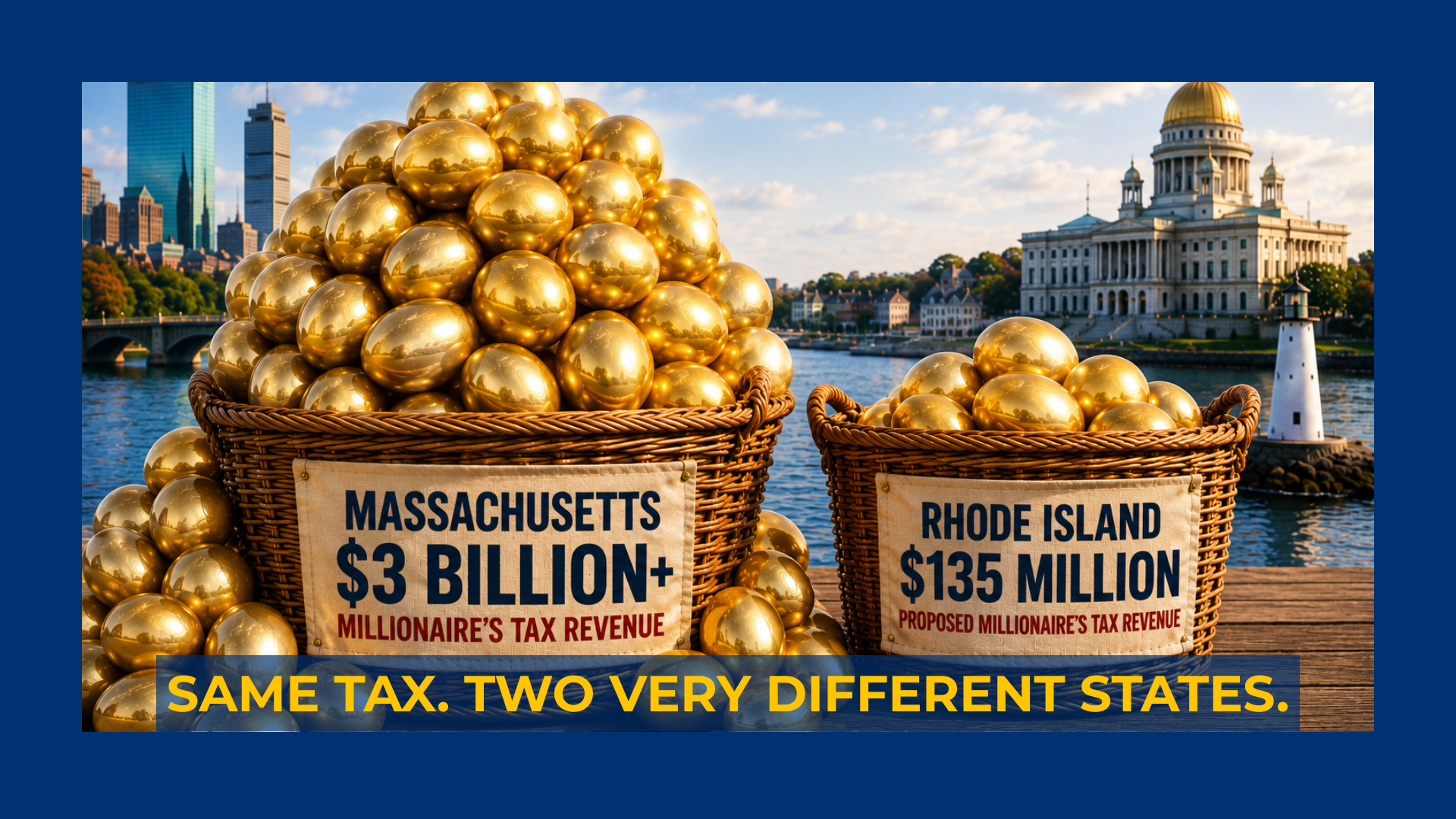
Massachusetts voters approved a 4% surtax on income over $1 million in 2022. Originally projected to raise about $2 billion annually, the tax is now generating more than $3 billion per year and could approach $4 billion in fiscal year 2026.
Supporters see this as evidence that fears of wealthy residents leaving the state were overblown, but there is an important detail that often gets overlooked.
Massachusetts is not Rhode Island.
While Massachusetts has generated billions in new tax revenue, it has also experienced significant outmigration.
IRS data shows the state lost nearly 30,000 more residents than it gained from 2022 to 2023. Among taxpayers earning more than $200,000 annually, there was a net loss of 8,678 individuals, representing nearly 29% of the state's total net outmigration.
Despite those losses, Massachusetts continues to collect enormous revenue from its millionaire's tax because it has a massive economy, a large population, and a deep bench of high-income taxpayers.
That distinction matters.
A Tale of Two States
Before we compare tax policies, we should compare the states themselves.
Massachusetts has a population of approximately 7.1 million residents and a state budget approaching $62 billion.
Rhode Island has approximately 1.1 million residents and a state budget approaching $15 billion.
Massachusetts has more than six times Rhode Island's population and a significantly larger economy, workforce, and concentration of high-income taxpayers.
Massachusetts isn't generating billions from the millionaire's tax because the policy itself is magical. It's generating that revenue because Massachusetts already has a very large pool of million-dollar taxpayers.
When Massachusetts loses a few thousand high-income residents, it still has a deep tax base capable of generating billions in revenue.
Rhode Island is different.
Today, lawmakers are considering two separate tax proposals aimed at high earners.
One proposal would impose a 3% surtax on Rhode Island's top 1% of earners, beginning at approximately $640,000 of annual income. Supporters estimate it would generate roughly $203 million annually.
Governor McKee's proposal would apply to income above $1 million and is estimated to raise approximately $135 million annually.
In either case, the entire proposal relies on a relatively small number of taxpayers.
According to supporters of the legislation, only about 6,100 Rhode Island tax filers would be affected.
That is where the risk comes in.
Massachusetts can lose thousands of high-income taxpayers and still collect billions because its tax base is so large.
Rhode Island doesn't have that luxury.
If even a modest number of Rhode Island's highest earners decide to relocate, change residency, defer income, accelerate deductions, or alter investment decisions, the projected revenue could quickly fall short of expectations.
This isn't speculation. It is simply the reality of relying on a small group of taxpayers for a growing share of state revenue.
Are We Getting Our Money's Worth?
There is another important piece of context that rarely gets discussed.
Rhode Island's proposed state budget is now approaching $15 billion.
For a state with approximately 1.1 million residents, that represents an investment of roughly $13,600 per resident every year.
Massachusetts, by comparison, has a budget approaching $62 billion and a population of roughly 7.1 million residents. That works out to approximately $8,700 per resident.
That doesn't automatically mean Rhode Island spends too much.
Every state has different needs, priorities, and challenges, but it does raise an important question: Are Rhode Islanders getting their money's worth?
Are our roads, bridges, schools, healthcare system, housing policies, regulatory environment, and economic opportunities producing results that justify a public investment of nearly $13,600 per person?
If the answer is yes, then taxpayers should be able to clearly see those results.
If the answer is no, then we should be asking why.
Before asking a small group of taxpayers to contribute more, Rhode Islanders deserve an honest conversation about how effectively the state is using the resources it already has.
The question isn't simply how much government spends.
The question is what Rhode Islanders receive in return.
Treating the Symptom or Fixing the Problem?
This debate reminds me of another challenge Rhode Island is facing in healthcare.
Many policymakers recognize that Rhode Island has a shortage of primary care physicians. One proposed solution is building a new medical school.
But building a medical school doesn't address the reason many doctors are leaving or choosing not to practice here in the first place: reimbursement rates that lag neighboring states.
In other words, we're focusing on the symptom instead of the underlying problem.
The millionaire's tax raises a similar question.
If Rhode Island needs more revenue because government spending continues to grow faster than our economy, are we addressing the root cause or simply finding another source of funding?
Raising rates on the top 1% may generate additional revenue in the short term.
Just as a medical school may eventually produce more doctors.
But neither policy automatically fixes the structural issues that created the problem in the first place.
Before we ask a small group of taxpayers to contribute more, we should also be asking why Rhode Island spends more per resident than Massachusetts, whether taxpayers are receiving value for that spending, and what reforms could make government more efficient and effective.
The goal should not simply be to raise more money.
The goal should be to produce better results.
Looking Ahead
At this point, it seems increasingly likely that some form of a millionaire's tax will become law in Rhode Island.
If that happens, I hope supporters are right.
I hope the revenue projections are accurate.
I hope the state experiences little or no outmigration.
I hope the additional revenue is invested wisely and produces measurable improvements for Rhode Islanders.
But passing a tax is not the same thing as solving a problem.
The real test won't be how much money the tax raises in its first year.
The real test will be whether Rhode Island becomes a more affordable, competitive, and prosperous place to live, work, raise a family, and start a business.
Supporters and opponents can debate whether a millionaire's tax is fair.
That's a legitimate discussion.
But fairness alone doesn't determine whether a policy is sustainable.
The reality is that Massachusetts has a much larger margin for error than Rhode Island.
When it comes to tax policy, size matters.
And before we celebrate Massachusetts as a model, we should recognize that Rhode Island is playing a very different game.
